Ninety Seconds to Midnight
We are barreling toward institutional crisis. Democrats have a choice to make. They must make the right one.

I must preface this article by saying that, although I am no stranger to writing about American politics on this website, the tone of this piece is unlike anything I have written thus far. I did not plan to write this before yesterday, but I feel it is my responsibility to speak out and articulate my position on what has rapidly become one of the most severe problems facing this country. This is Ninety Seconds to Midnight.
The dust has yet to settle from the Virginia Supreme Court’s shocking ruling nullifying the gerrymandered congressional map passed in the April 21 statewide referendum. In an instant, a crucial counterweight against a Republican-originated gerrymandering push was destroyed.
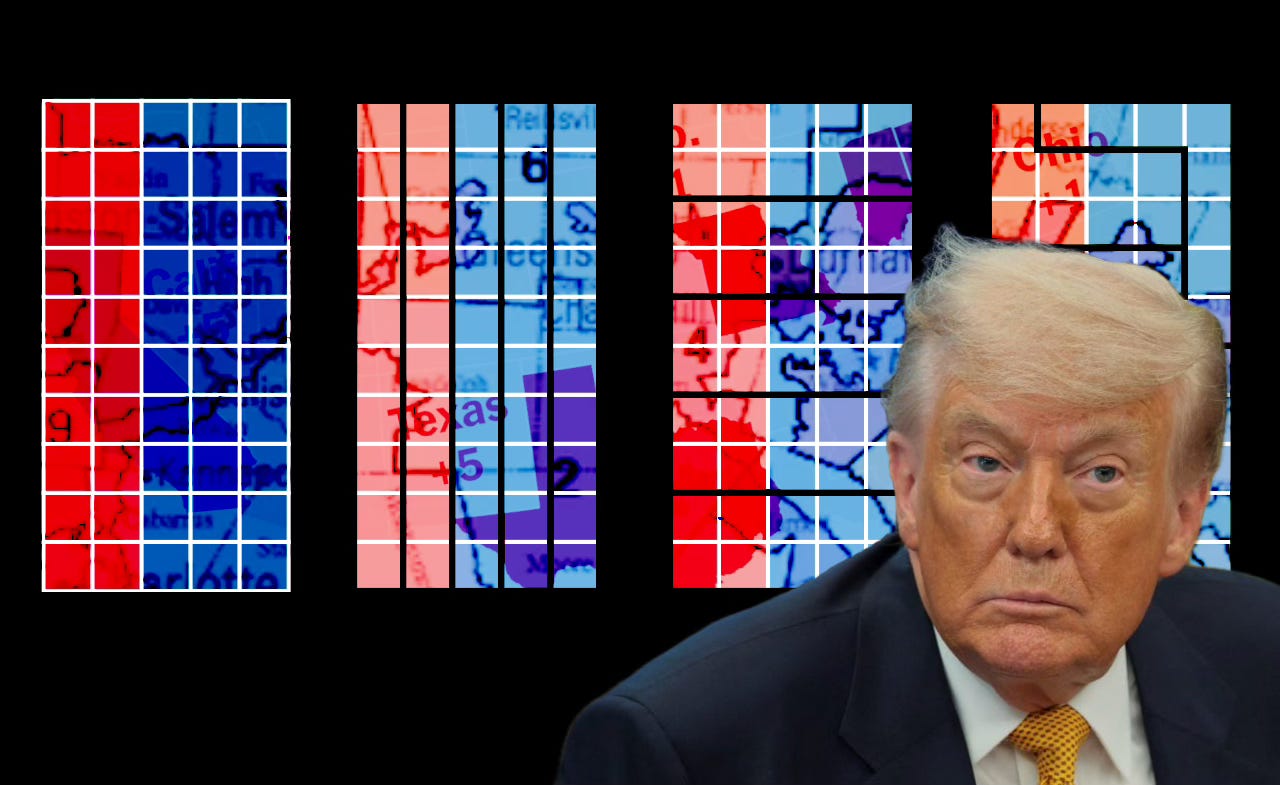
Now, in the 2026 elections, Democrats will have to compete against a party that has, by mathematical manipulation of partisan boundaries, engineered a swing of nearly a dozen seats in its favor. In a year where President Donald Trump’s approval ratings are sinking faster and deeper than any of his predecessors, in a year where the congressional ballot is polling consistently in the high single digits for Democrats, there is a small—but very significant—chance that Republicans will be mauled nationally yet retain a legislative trifecta anyways.
Despite this, some Democrats have expressed opposition to redistricting further. Undoubtedly fueled by the disaster in Virginia, they have determined that further redistricting is too costly, too risky, and too divisive to push. Some of them may even believe that, should Democrats take the high road and refuse to redistrict, the Republicans will respond in kind, leading to some sort of gerrymandering détente.
They are wrong. There is nothing Democrats can do to prevent Republicans from maximizing their chances by drawing as many gerrymanders in as many states as possible.
Part of the reason this is impossible is because Republicans will never concede that, prior to this mid-decade redistricting push, the status quo was largely fair. Though both sides of the political aisle had participated in partisan gerrymandering prior to the second Trump presidency, the effects had largely canceled out. The Republican REDMAP plan, though egregious, had largely been mitigated on the congressional level through court-ordered redraws courtesy of Section 2 of the Voting Rights Act (more on this later). In the 2024 House of Representatives elections, the difference between the national Republican vote share and the percentage of seats they won was one percent.
One point Republicans make pursuant to this line of thinking is that New England has no Republican representation in Congress despite over forty percent of its population voting for Donald Trump in the 2024 presidential election. This, they claim, is surefire evidence of Democrat gerrymandering.
This notion is rooted in a misconception of what is and is not a gerrymander. Legislative districts have, historically, not been drawn to create a number of seats proportional to how that state’s population votes. They have been drawn to naturally fit the various constituencies in each state. County lines, municipal boundaries, and ethnic communities have all been taken into consideration under longstanding precedent to create maps that, although not proportional to the state’s vote totals, are nonetheless reflective of that state’s population.
For this reason, Massachusetts’ congressional map, despite being unanimously Democratic, is not a gerrymander. Democratic voters are large in number and widely distributed enough to naturally creates inefficiencies for Republicans, absent intentional gerrymandering. A congressional map of Massachusetts in which a variety of Republican communities are mashed together haphazardly to create one or two congressional districts is, despite being more proportional than the status quo, a Republican gerrymander.
Moreover, this principle benefits both parties in their safe states. Arkansas, Iowa, Oklahoma, Nebraska, and Montana all have maps that send unanimous Republican delegations to the Congress. Republicans seem to have no problem with these lopsided congressional maps.
Using this faulty and often dishonest justification, Donald Trump and the Republican Party have launched a redistricting that has, in recent years, violated every possible norm, law, and institution set up to prevent exactly this from happening.
In 2022, the Ohio Supreme Court instructed the Republican-controlled Ohio legislature to redraw their gerrymandered congressional maps. The legislature refused, stating that it was simply too close to the election to justify redrawing maps.
Three years later, Donald Trump used his intra-party clout to compel Texas and Missouri to redistrict, drawing out about a half-dozen Democrat-held seats in total. Democrats, burned by their ratification of independent redistricting commissions in their own states, quickly retaliated by holding statewide votes in California and Virginia, in hopes of temporarily suspending each state’s commissions.
As both of these passed, it seemed like the redistricting war had largely become a wash. It even seemed like a deescalation was possible, as Republicans backed off Indiana and Democratic leaders returned the favor by sparing Andy Harris in Maryland.
It did not last long. As Trump aggressively moved to punish the Indiana senators who resisted him, liberal Supreme Court justices desperately tried to slow-walk the impending Louisiana v. Callais ruling until it could no longer affect the 2026 midterms.
Time ran out in April 2026, when the U.S. Supreme Court ruled that the existing congressional map in Louisiana was an unconstitutional racial gerrymander. Without even a hint of irony, they used the postwar amendments, passed to enshrine the rights of Black Americans into the constitution, as a justification to gut the Voting Rights Act and allow state legislatures to shred Black-majority districts.
The floodgates were open. In a matter of days, Republican state legislatures across the Southeast had convened and passed gerrymanders, aiming to stomp out over a dozen Black-majority congressional seats occupied by Democrats, including civil rights leader Jim Clyburn.
Nothing was off the table for them. In Utah, where the Utah Supreme Court had mandated the creation of a single Democratic district anchored in Salt Lake City, the Republican state legislature ruthlessly moved to pack the state court, even forcing one justice involved in the ruling to resign. Though Republicans had previously packed courts in Arizona and Georgia, this was the first time they had done it to punish a state supreme court for ruling a certain way in a redistricting case.
In Tennessee, gubernatorial candidate Marsha Blackburn was naked with her calls, posting on Twitter that drawing out Tennessee’s final Democratic district is “essential” to cement Donald Trump’s “congressional agenda.” After drawing out the state’s only remaining Black-majority and Democratic-leaning seat, Tennessee State House speaker Cameron Sexton punished state Democrats for protesting by unilaterally removing all of them from their standing committees.
In Florida, Governor Ron DeSantis passed and signed a brutal gerrymander aiming to gouge out four Democratic districts. He also made no secret of his intention, passing copies of the map to FOX News before the state legislature and openly admitting that the map is illegal under the state constitution forbidding partisan gerrymandering.
Perhaps the most egregious of them all is Louisiana. Disregarding the doctrine they promoted in Ohio in 2022, they terminated an ongoing election to redistrict, throwing out over 40,000 ballots in an effort to draw out one of Louisiana’s Black-majority seats.
Now, the Virginia Supreme Court has struck down one of Democrats’ only safeguards to these abuses.
Before discussing the future, we must rid ourselves of the notion that Republicans, at least under Donald Trump and his ilk, would ever be willing to compromise on the matter. He did not call on Texas to begin this gerrymandering war to resolve any perceived unfairness in America’s existing congressional maps.
If every map were proportional, Trump would justify his mid-decade redistricting push by saying that the Democratic Party is inherently dangerous and needs to be eradicated, and that the presence of any Democratic districts at all in Republican states is inherently a Democratic gerrymander.
Let us also not be deluded into thinking that the southern assault on Black-majority districts was a response to the Virginia map, regardless of what they insist after the fact. The annihilation of the Voting Rights Act has been years in the making, and it has been a longtime pet project of Chief Justice John Roberts.
As a Justice Department clerk under President Ronald Reagan, Roberts fought against expanding the Voting Rights Act. After his appointment to the bench, the Supreme Court smashed Sections 4 and 5 of the Voting Rights Act, leaving Section 2 the only functioning pillar of the Act.
Now it is gone, spurred on by a lawsuit that predates the Virginia election result by over a year, and southern state legislatures pounced on a new opportunity to disenfranchise their Democratic minorities.
Let’s call a spade a spade. This country is staring down the barrel of a rigged midterm election. These maps are illegal, unprecedented, and violate every norm around redistricting.
Some may still dismiss these concerns as alarmism, convinced that this electoral chicanery amounts to nothing more than political hardball, a way for Republicans to extend their tax cuts and immigration raids for the remainder of this presidential term. Willfully ignoring the rapid drop in barometric pressure cannot change what has happened over the course of this decade.
It was not six years ago that Republicans attempted to steal away the presidency by way of “alternate electors.” Their second plan was to so thoroughly mangle the Electoral College count that the election would be sent to a contingent election in Congress, tearing the electoral system to pieces and the country with it.
This culminated in the January 6 attack, when a mob of rioters instigated by Donald Trump got within feet of murdering members of Congress, as well as the sitting Vice President. They were pardoned, without exception, by Trump upon his return to office.
Now, the worst has come to pass. The most powerful man in the White House has claimed that the Democratic Party is no longer a political party, instead labeling it a “domestic extremist organization.” What does this classification imply? He says this while his political allies tear pages from the Project 2025 playbook, systematically and unhesitatingly destroying every norm, law, and institution that stands in their way. The noose is tightening.
All the while, there is radio silence from the “moderate,” “respectable” Republicans. Not only do they not criticize their rogue administration, they instead grovel at Trump’s feet, parroting his talking points and dutifully playing along. Of course, there are still select holdouts, people like John Thune who admirably refuse to scrap the filibuster, but he and his ilk are on their way out. It is not long before they go the way of the Indiana Republicans who nobly struck down Trump’s gerrymander.
However, not all is lost. Democrats carry legislative trifectas in sixteen states, under which there are still Republican-held congressional seats. This massive base of statewide power gives them ample leverage to resist.
All that is left is a choice.
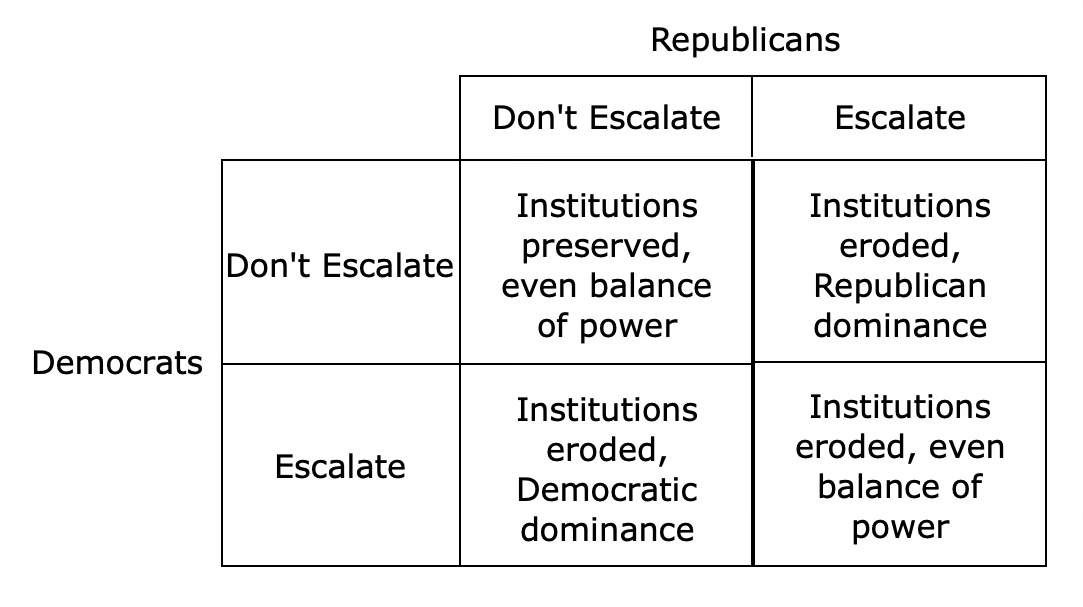
Republicans will not yield, at least not as long as they continue down the path they have traveled down for the past decade. It is a prisoner’s dilemma, and they understand this. They have violated every norm in their pursuit of legislative power. Judicial independence, the Purcell Principle, the Voting Rights Act, all thrown into the shredder in an attempt to muscle their way into supremacy over the United States government.
Democrats can, if they want, turn the other cheek. This is the easiest option to take, and it is the one that best preserves their moral high ground. They need not change their behavior, leaving in place every Democratically-installed independent redistricting commission, forgoing mid-decade redistricting entirely, and stick to the same pleas and platitudes cycle-in and cycle-out.
Meanwhile, Republicans will solidify their control. They will maximize every state, relentlessly gaming the system just like they did in 2026. Before Democrats know it, the House could slide permanently out of competition. Maybe they get lucky and elect a progressive president every now and then, but with the Democratic trifecta rendered extinct, they will be able to do little to control the direction of the country.
If this course is taken, Republicans will win trifectas sooner and more often. They will use this to tighten their grip on power, continuing their efforts at voter suppression and electoral rigging until America is a one-party state. The Democratic Party will exist on paper, as will most organs composing our branches of government, but little more than that.
Is this how a republic dies? It’s difficult to say, but if Democrats willingly slot themselves into the role of controlled opposition, it’s very likely. And the great irony of this response is that Democratic compliance will only serve to confirm the viability of this strategy to Republicans, emboldening them to go further and further.
Or, Democrats can start responding in kind. It is tragic, it is difficult, and it will hurt people, but it is also serious, viable option that should be explored. Once one side abandons redistricting norms, unilateral restraint by the other side becomes strategically irrational. Though this course will accelerate the collapse of checks and balances, it will be more democratic and more representative than the alternative because it maintains an equilibrium, albeit a chaotic and destructive one.
The silver lining of Republican redistricting atrocities is that Democrats now have a justification to follow suit. They can quickly and aggressively move to gerrymander every single state in which they retain a trifecta. It is possible to make safe, unanimous gerrymanders in states like California, Washington, Oregon, Colorado, Illinois, Maryland, Maine, and New York. These maps will be atrocities, resembling computer chip circuitry more than a congressional map.
In other states like Minnesota, Virginia, and New Jersey, it is possible to pack Republican support into one district while shoring up the rest of the map, greatly expanding the current edge on power.
The Utah precedent of court packing can be used to threaten or outright pack the judiciary in states like New York, California, and Illinois, should they prove unreceptive to these redistricting efforts. Impeach any judge or justice who resists, and replace them with a dozen partisan hacks willing to rubber-stamp anything the legislature sends them.
And, if the law gets in your way, do something about it. Bend it, circumvent it, and break it if necessary. Halt elections if you must. This is only the precedent set by Florida and Louisiana.
Mutual escalation is by no means a desirable permanent solution. The upcoming 2030 census is going to be difficult, and Democratic states in the north and west coast are going to lose more people to the Republican strongholds of Florida and Texas. If the battle lines remain stable for decades, these progressive strongholds will continue to lose electoral votes, and Republican domination will arrive all the same.
But, if Democrats play their cards right, this outcome could be delayed. Maybe they can slow it further by slashing taxes and regulations, YIMBY-ing their states as much as possible at the cost of core parts of their coalition. They could also adopt tough-on-crime policies to counter the perception of Democratic states as dangerous due to weakness on crime. This could make life affordable and safe enough to stem the flow of regional migration, buying Democrats precious time to weigh their options.
There is, however, a light at the end of the tunnel. This light is proportional representation. Under such a model, individual congressional districts would be eliminated. Each state would keep its representatives, but they would be allocated proportionally by a statewide popular vote. This would require time to work out the kinks, but it would make it virtually impossible to game the system in the way we currently do.
Congressional districts are a superior system in a vacuum because they are more connected to the people and better represent local interests, but it has been proven time and time again that the United States cannot be trusted to handle them fairly.
The best part is that this is achievable not by constitutional amendment, but by simple federal statute. The Elections Clause of the U.S. Constitution (Article I, Section 4) gives Congress authority to “make or alter” state regulations governing the “Times, Places and Manner” of congressional elections. The Supreme Court has, historically, interpreted that power very broadly.
Indeed, the current “paragons” of congressional seat allocation—the division of states into geographic districts, the prohibition of multi-member districts, and the winner-take-all method of allocating electoral results—are all simple federal statutes. They are just as vulnerable to modification as any issue of the day. All that is required to replace them with a stronger system is 218 votes in the House of Representatives, fifty Senate seats, and a Vice President willing to break the tie. This future is placed in jeopardy if Democrats forfeit their leverage for the sake of moral superiority.
Of course, Republicans will never support this. They remain steadfastly opposed to all electoral reform. That is why it is on Democrats to get wise, play the Republicans’ game, and stall until they can pass a permanent solution to this problem. Or they can continue down their current path, dooming America to oblivion and ensuring the destruction of every demographic that relies on their political power for safety and support.
American institutions are in a state of collapse, and there is no good choice remaining. It’s a lose-lose situation, one where your choices are to admit defeat or escalate the war until you can force the country onto an off-ramp. It is a solution that will involve, for a time, embracing the very tactics you aim to end. It is painful, deeply unethical, and should not be taken lightly. But there is a choice.